Legacy systems usually still work; that is why they are still running. The risk is in what surrounds them: unsupported frameworks, one person who understands the code, and features nobody dares to touch.
We modernise incrementally — strangling the old system piece by piece behind a stable interface — so the business keeps operating and every step is reversible.
In practice, modules move across one at a time while the old system keeps running, sound stored procedures and data structures are reused rather than rewritten, reports are rebuilt in a supported engine, and automated tests are added as each part moves so it stays correct afterwards.
From our recent work
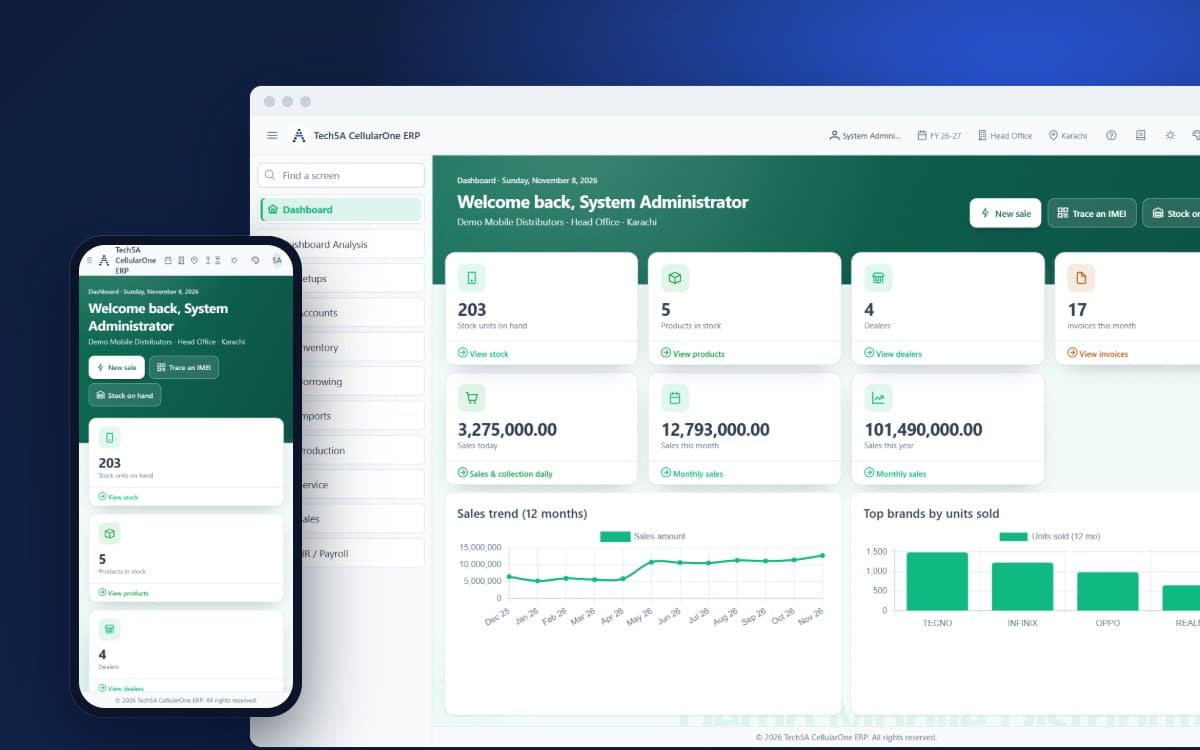
- Tech5A CellularOne ERP: a distribution ERP with hundreds of WebForms pages and around 400 Crystal Reports, rebuilt module by module on .NET 8, Vue 3 and FastReport, with about 3,000 automated tests.
- A sales CRM moved from 167 WebForms pages on .NET Framework 4.8 to a .NET 8 API and a Vue 3 app, reusing its 459 stored procedures and adding nearly 700 automated tests.
- An inventory and invoicing app upgraded from .NET Core 3.1 and Serenity 3 to .NET 8 and Serenity 8, with integration tests against a real SQL Server in containers.
- A POS terminal management system modernised onto React 19 and Node.js, then containerised and moved to a shared PostgreSQL server.
What is included
- Legacy assessment and modernisation roadmap
- ASP.NET WebForms and .NET Framework to .NET 8+ migration
- Crystal Reports rebuilt in FastReport or QuestPDF
- Database clean-up, schema migrations and data migration
- Move from on-premise IIS to Docker or the cloud, if wanted
- Decommissioning plan for the old system
Who this is for
Companies running business-critical software built more than seven or eight years ago.
Common questions
- Rewrite or refactor?
- Almost always refactor and migrate incrementally. Big-bang rewrites fail far more often than they succeed; we only recommend one when the old system is beyond saving.
- Can the old and new systems run side by side?
- Yes, and that is how we prefer to do it. Modules move one at a time, users switch when each one is ready, and the old system is retired only when nothing depends on it.
- What happens to our Crystal Reports?
- They are rebuilt in a supported report engine such as FastReport or QuestPDF, keeping the layouts your users rely on, and produced as PDF or Excel from the web application.