About the project
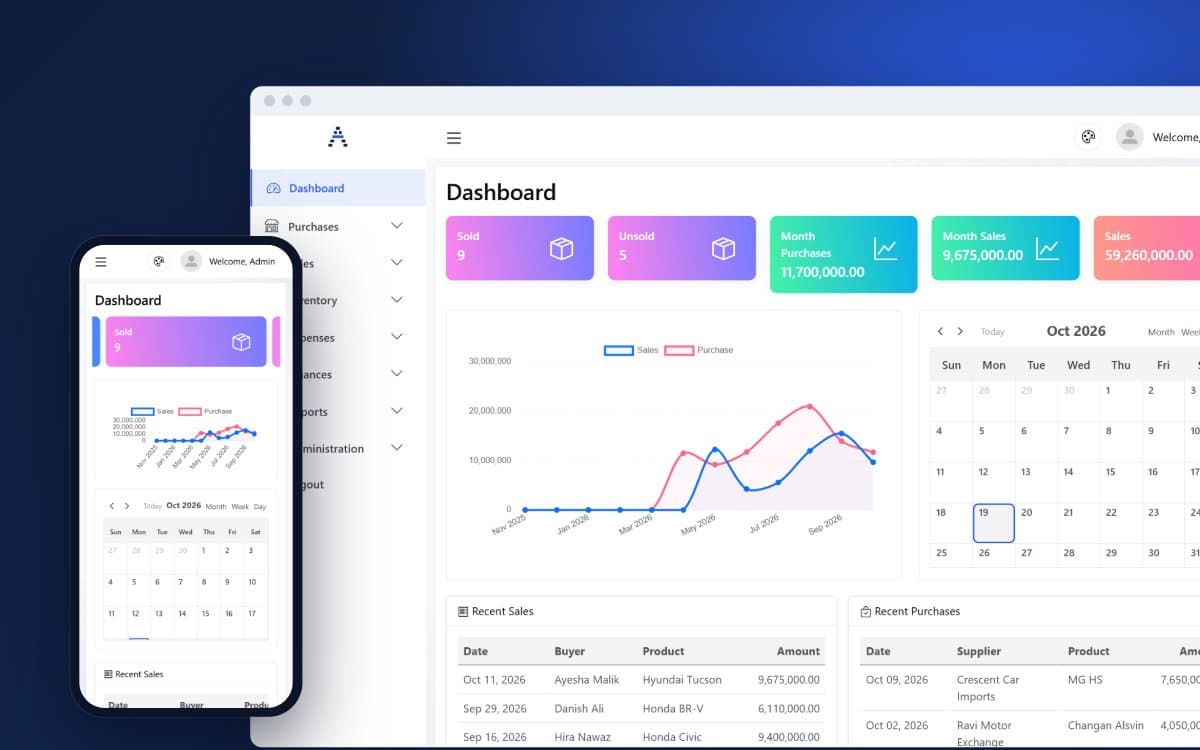
A car dealer needs to know which cars are on the floor and for how long, who still owes on an instalment plan and whether the month made money. Tech5A Vehicle Management System keeps purchases, stock, sales, returns, expenses and accounts in one web application. One install serves any number of dealers, each with its own users, chart of accounts and logo on its invoices.
A purchase brings a car into stock with its registration, engine and chassis numbers, against the supplier's account. The supplier is then paid car by car. A sale records the customer, discount and tax, paid in full or on an instalment plan, and takes payments until the balance is clear. Each of these, and every sales or purchase return, posts its own double-entry journal. The trial balance, income statement, balance sheet, ledgers and the payable, receivable and stock ageing reports all read from the same books. Cash and bank vouchers draw cheques from each bank account's cheque book, and every list and report prints and exports to PDF and Excel.
Each car in stock has a sale listing. Its mileage, transmission, fuel, condition and features are picked from fixed lists, never typed. AI drafts a title, a description and highlights from those facts and the make, model, year, variant and colour. Registration, engine and chassis numbers, prices and the supplier are never sent. A check drops claims the car's record does not carry, such as 'accident-free' or 'one owner', and adds facts the draft left out. A person reads the draft, copies it in and saves. Five test cases, one of them an injection attempt, measure every change to the prompt.
The AI runs on a self-hosted Ollama model by default, or on one of sixteen providers, including OpenAI, Claude, Gemini, Mistral and Groq. The provider is chosen under App Settings, with a main server and a backup that answers when the main one cannot be reached. Drafts are made in the background, so no page waits for them. Daily limits per user, per dealer and in total, a daily spend budget, cached answers and encrypted keys keep it cheap and safe. An AI usage report shows the calls, tokens and estimated cost by feature and by model, at prices the operator enters.
An activity log records every page opened, every save, delete and download, refused sign-ins, and each call to an AI provider with what was sent and what came back, with keys hidden. The platform owner can narrow it to one person, one browser session or one AI model, and export it.
It is an ASP.NET Core 8 application on SQL Server, with Clerk, Manager, Admin and Super Admin roles for each dealer. The product's name, logos and sign-in text are set under App Settings, and each user chooses light, dark or automatic mode and one of twelve accent colours from the top bar. A first-run page sets up the database connection. It runs in Docker behind Caddy on Ubuntu, with install, update and backup scripts, and has 177 automated tests.